Oregon's Data Center Reality Check

Ratepayers. Farmers.
Schools. Watersheds.
Oregon.

For every claim made by the data center industry, there's a community bearing a real cost. Here's what the industry-funded studies leave out.

See the Other Side
What the industry says vs. what the numbers actually show
They claim: 65,530 jobs
2,630
Direct on-site data center jobs statewide — about 0.2% of Oregon's workforce, across 111 operating facilities
ECOnorthwest / University of Virginia, 2026
They claim: $1B+ in tax revenue
$60M
Property taxes Oregon's data centers paid in 2025 — against an estimated $230–450M in taxes exempted
ECOnorthwest / University of Virginia, 2026
They claim: 550% efficiency gain
23%
Of all retail electricity sold in Oregon went to data centers in 2025
ECOnorthwest / University of Virginia, 2026
They claim: clean energy leaders
2065
When U.S. coal plants will finally retire at today's pace, as data center demand keeps fossil plants online — vs. 2040 at the 2022 pace
US PIRG / Environment America, 2026
They claim: $727M funds libraries
$29M
Net loss to Crook County Schools from tax abatement programs in 2024
Good Jobs First, via The Source Weekly

$60 Million Paid. Up to $450 Million Exempted.

Oregon Connects claims: Data centers generate "$10.4 billion in total GDP impact" and "over $1 billion in annual state and local tax revenue." Their source: a study commissioned by the data center industry itself.

The headline numbers look impressive... until you look at what Oregon gives back.

  • Research by Good Jobs First finds that tax subsidies "play almost no role in data center site location decisions" — companies choose Oregon for cheap electricity and favorable climate, not incentives. (Good Jobs First)
  • An independent 2026 study by ECOnorthwest and the University of Virginia found Oregon's operating data centers paid about $60 million in property taxes in 2025 — while an estimated $230 million to $450 million in taxes was exempted. (OPB, 2026)
  • Hillsboro community advocate Dirk Knudsen, working from tax statements and his own audit, estimates the Hillsboro School District has lost upwards of $140 million to data center tax breaks. (OCPP, 2026)
  • Crook County Schools saw a net loss of $29 million from tax abatement programs in 2024, according to the policy resource center Good Jobs First. (The Source Weekly, 2026)
  • Hillsboro has signed staggered enterprise zone agreements that keep some data center campuses exempt from property taxes through 2051 — roughly 25 years, regardless of how community needs change. (Hillsboro Herald, 2026; also reported by The Oregonian)

2,630 Jobs Across 111 Data Centers

Oregon Connects claims: Data centers support "65,530 jobs across the state" and "9,300 direct workers," with each position supporting approximately six additional jobs and contributing "$5.6 billion in annual labor income."

The "permanent" jobs are not what they appear.

  • An independent 2026 study by ECOnorthwest and the University of Virginia counted just 2,630 direct data center employees across 111 operating facilities — about 24 per facility, and roughly 0.2% of Oregon's workforce. Even the industry's own 9,300 figure works out to fewer than 85 jobs per facility. (OPB, 2026)
  • Construction jobs are real but short-lived: "following construction, the jobs slow to a trickle, while the tax breaks remain longer." (The Source Weekly editorial, 2026)
  • X's facility in Washington County employs just 18 people — yet Twitter (now X) received more than $300,000 in property tax breaks per worker in 2022. (OCPP, 2024)
  • Speaking of TikTok's data center presence in Hillsboro, advocate Dirk Knudsen estimates: "The community's paying $520,000 a year per employee to have them here." (OCPP, 2026)
  • The 65,530 figure comes from an industry-commissioned study that counts "indirect" and "induced" multiplier effects — estimated spending ripples across the whole state, not people working at data centers. That methodology can make almost any large capital project look transformative on paper.
  • Data centers compete with other industries for scarce industrial land, while research by The Oregonian found that almost none of the state's tax breaks were going to chipmakers — despite Oregon being a leader in semiconductor manufacturing. (Data Center Knowledge, 2023)
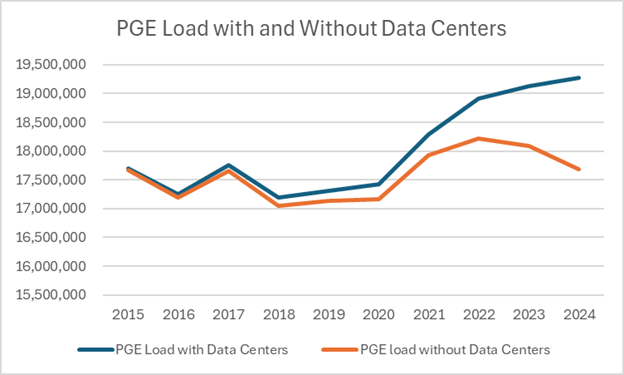
PGE electricity demand growth without data centers — Oregon CUB chart
Chart: Oregon CUB

That Efficiency Stat Is Six Years Old

Oregon Connects claims: "Computing workloads increased nearly 550 percent between 2010 and 2018" while "electricity consumption grew only six percent." Implication: data centers have their power footprint under control.

That pre-AI-era statistic describes a world that no longer exists.

  • The 2010–2018 efficiency comparison is drawn from a pre-AI-era dataset. In 2025, global data center electricity demand surged 17% in a single year — AI-focused facilities climbed even faster. (IEA, 2026)
  • Global data center electricity consumption is projected to more than double from 415 TWh in 2024 to ~945 TWh by 2030. (IEA Energy & AI Report, 2025)
  • Data centers accounted for about 23% of Oregon's retail electricity sales in 2025 — roughly 71% as much electricity as every Oregon household combined. (OPB / KPTV, 2026)
  • AI-specialized hyperscale campuses can draw as much as 1 gigawatt of electricity load. (Columbia Riverkeeper)
  • Oregon residential power bills are 50% higher than they were in 2020. Before the 2025 POWER Act, PGE's large industrial customers — including data centers — paid about 8¢/kWh while households paid about 20¢. (The Source Weekly editorial, 2026)
Manure lagoon near data center sites in Morrow County, Oregon

The Green Claims Don't Hold Water

Oregon Connects claims: Data centers represent "two-thirds of the total U.S. corporate renewables market" and four of the top five U.S. renewable energy purchasers operate data centers.

Buying a Renewable Energy Certificate is not the same as running on clean power — and no REC addresses the water crisis already underway.

  • Oregon's grid is hydro-heavy — but data center demand has increased some Northwest utilities' reliance on purchasing "dirty electricity": power from gas and coal burned in neighboring states with weaker environmental regulations. A Renewable Energy Certificate purchased by a data center doesn't change what's actually flowing through the wires. (Oregon CUB, citing Sightline Institute, 2025)
  • Nationally, rising data center demand is pushing utilities to keep fossil-fuel plants online longer. At the 2022 retirement pace the U.S. was on track for a coal-free grid by 2040; at the current pace, coal plants will linger until 2065 — a 25-year setback. (The Register, citing Energy Transition at Risk (US PIRG / Environment America), 2026)
  • In Morrow County, eastern Oregon, agricultural runoff has contaminated the groundwater for decades — and data centers are making it worse. Wastewater returning from data centers has averaged as high as 56 parts per million nitrates — eight times Oregon's safety limit of 7 ppm. One sampling of 70 area wells found 68 violating the safety threshold, averaging close to four times the federal limit. Nitrate exposure is linked to increased cancer risk and serious conditions in newborns, and an informal survey of residents counted at least 25 miscarriages and a half dozen people living with one kidney. (Rolling Stone, 2025, republished by WaterWatch Oregon)
  • About 85 miles west in The Dalles, a separate problem: Google's data centers used 29% of the city's water in 2021, and roughly a third by 2024 — with more data centers on the way. (WaterWatch Oregon / Oregon Capital Chronicle)
Data center political battle
Photo: Wired

Oregon Bears the Costs. The "Benefits" Are National.

Oregon Connects claims: Keeping data centers on American soil is "critical to our national security," and data centers provide "the digital infrastructure that ensures U.S. competitiveness in artificial intelligence."

National security is a concern but not a justification for Oregon communities to absorb costs that benefit the entire country.

  • National security benefits are diffuse and shared by all Americans. The water pollution, rising utility bills, and lost school funding land on Oregon ratepayers, school districts, and communities.
  • Oregon is already the second-largest data center market in the United States, behind only Virginia. No additional subsidies are required to keep Oregon "competitive" for this industry. (Columbia Riverkeeper)
  • Data centers take up large footprints of scarce industrial land with minimal staffing — a single facility near Hillsboro put ten acres under roof. Statewide, the industry employs only about 0.2% of Oregon's workforce. (OCPP / OPB, 2026)
  • In Washington County, eight employees collectively devote thousands of hours per year to managing tax incentive programs whose administrative costs the county ties to data center growth — a hidden cost borne by local taxpayers. (GovTech, 2026)
  • Data center growth could "squash dam removal efforts and threaten salmon recovery" as utilities scramble to meet power demand — undercutting decades of Pacific Northwest environmental progress. (Columbia Riverkeeper)

Oregon Deserves the Full Story

The industry has a well-funded lobbying operation and a commissioned study. Oregon communities have the facts. Read the independent reporting and make your voice heard.

Contact Your Legislator Read the Coverage
Organizations doing the work
Columbia Riverkeeper WaterWatch Oregon Oregon Center for Public Policy Oregon CUB KLCC Podcast

In The News

What Oregon's journalists are actually finding